Showing posts with label sewing. Show all posts

Monday, May 13, 2013

Happy Mother's Day: Quilter's Edition

I don't know about all the other mommies I know, but I had THE MOST WONDERFUL Mother's Day courtesy of my wonderful husband and our little minions. I got my favorite breakfast (pancakes!!!) made and ready for me when I was done sleeping in. I got some beautiful flowers, and I also got some cards with options for the day's activities. My options were:
  1. Go to the aquarium.
  2. Go to a NEW quilt shop.
Hmm... I absolutely LOVE the aquarium. Probably more than the average person. I love the aquarium like children love the aquarium. Yes, that's it. I'm a huge woman-child when it comes to going to the aquarium. But the quilt shop... I felt selfish picking that one, but Scott actually anticipated I'd pick that one and bought me some Swedish fish (which I also love) so I could get my own kind of aquarium experience. I suppose he knows me better than I think.

QUILT SHOP!!! He took me to the Fabric Shack in Waynesville, OH, and it was the most amazing fabric experience I've ever had in my life. We were there for a couple hours, I think, but I made my seemingly-selfish outing about my kids. What better way to spend Mother's Day than to start a quilt for your firstborn? Yay! It's not about me, anymore!

The people there were amazing! This is the stash I ended up with before I left. I think most of it's Moda fabric, which is my new favorite. The brown deer on the chartreuse are my favorite of this lot. Oh, and the RVs. They're pretty awesome, too. :)
I told myself I didn't want the quilt to be too 'baby', but it ended up a little 'kiddy' anyway. I don't care. I love it! (If you don't know the song by Icona Pop, it's one of Joey's favorite songs, and I just sang that as I typed it.)

Since I bought the fabric yesterday, I have completed my very first quilt block. Ever. And it is glorious.
So out of this seemingly selfish quilt shop outing for Mother's Day, came an awesome quilt block that I made and am immensely proud of. And it's all for Joey. (Rosie will get hers in time; no worries.)

Happy Mother's Day to me!

Wednesday, April 3, 2013

Quilted Spring Table Runner

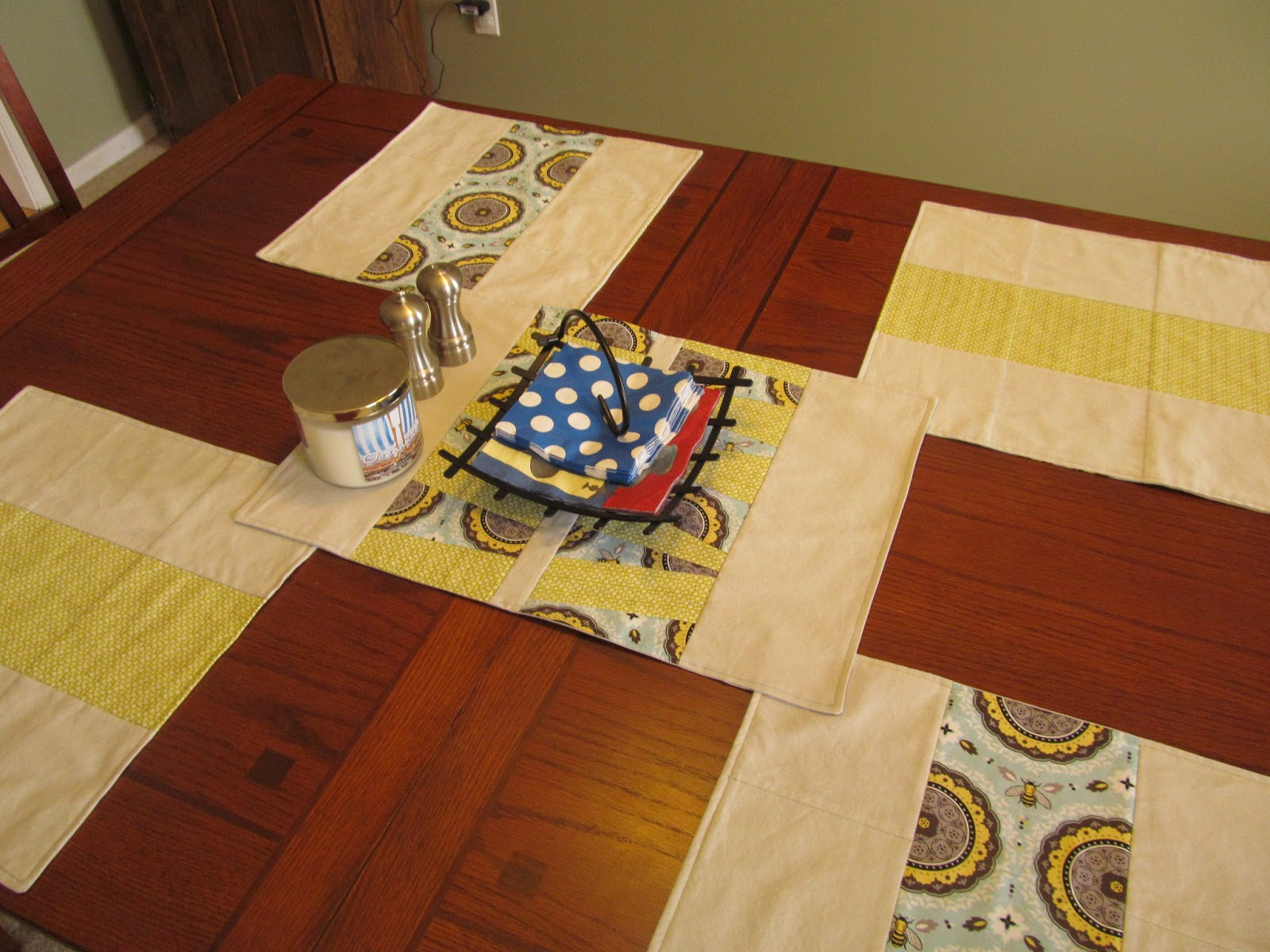
Now that you've had plenty of time to finish your beautiful spring placemats, here's what you can do with the scraps. Did I tell you how lovely your placemats were? Great job. :) Now let's make a table runner!

Quilted Spring Table Runner

Finished measurements: 20" x 14"
Seam allowance: 1/2" (unless otherwise stated)

materials
*scrap fabric pattern A
*scrap fabric pattern B
*solid-colored fabric
*coordinating colored thread

steps

1. Make sure your fabric is prewashed.

2. Cut solid-colored fabric to the following size specifications:
*5-1/4" x 15" (x2)
*1-1/2" x 15"
*21" x 15"

Make sure all pieces are pressed.

3. Cut both patterned fabrics into rectangles about 2-3" longer than what you need by anywhere from 3-7" wide. This pattern calls for 5" quilted stripes so I cut my rectangles about 7" x 5" (or so). There's really no exact science for this part as long as the pieces are long enough.
4. Take a fabric A rectangle and a fabric B rectangle and lay them on top of each other RS together at an angle. Stitch the long side of the top piece at 1/4". Press open.
5. Lay another rectangle on top of the one you just sewed RS together at an angle (you'll probably want the angle to be the opposite direction of the one you just made). Sew the long side of the new top piece at 1/4" and press open.
6. Now you'll keep doing this until your quilted strip is as long as you need it. If you're having trouble with the organized chaos of the angles of each piece, you can always place it at the angle you want (like above) and then fold it open to get an idea of what it will look like.
7. Now it's time to cut the strip to the correct size. This is where it really starts to come together. Using a straightedge, cut one side straight using the shortest piece of fabric as a guide (see picture). Then use the straightedge to cut the quilted strip to 5-1/2" wide.
8. Then comes the easy part of cutting it to the correct height of 15". Use your fabric as a guide, and just cut whichever side strikes your fancy; as long as it's 15" tall. Do this twice and you've got your 2 quilted strips! Now for the easy part.
9. Lay a quilted strip on top of a solid-colored piece (5-1/4" x 15") RS together. Stitch a long side at 1/4". Press open.

NOTE: When sewing the quilted piece on your sewing machine, make sure the folds are going under the presser foot backwards so they don't get bunched up under there.


10. Lay the skinny solid-colored piece (1-1/2" x 15") on top of the other side of the quilted strip you just sewed RS together. Stitch a long side at 1/4". Press open.

11. Lay the second quilted strip on top of the other side of the skinny solid-colored piece RS together. Stitch the long side at 1/4". Press open.
12. Lay a solid-colored piece (5-1/2" x 15") on top of the other side of the second quilted strip RS together. Stitch the long side at 1/4". Press open. Now you have the top of the runner done!

13. Lay the runner on top of the large solid-colored piece RS together. Stitch all around (1/2" seam allowance) leaving 2-3" for turning inside out.

14. Clip corners and turn inside out. Press.

15. Choose a color for the decorative stitching and stitch 1/4" all the way around the outside.

Since this piece isn't reversible (like the coordinating placemats), it doesn't really matter which color of the coordinating thread you choose for the stitching. I chose the blue because it popped more than the chartreuse.

16. "Stitch in the ditch" for both sides of both quilted strips (4 stitch lines).


And now you have a beautifully quilted table runner that will match either side of your reversible placemats. This was also my very first quilting project, and I have fallen in love with quilting! If this is going to be your first quilting project, you picked a good one. :)

Tuesday, April 2, 2013

Easy Spring Placemats

I have finally gotten tired enough of the weather where I am now trying to do everything in my power TO FORCE SPRING UPON US. I'm tired of this cold weather, already. So I found some beautiful springy fabric, made up a super easy sewing pattern, and I ended up with 4 reversible cheerfully spring placemats for our table. Yay!

Easy Spring Placemats (makes 4 placemats)

Finished measurements: 15" x 15"
Seam Allowance: 1/2" (unless otherwise stated)

 materials
*pattern fabric A:  6" x 16" (x4)
*pattern fabric B: 6" x 16" (x4)
*solid-colored fabric: 6" x 16" (x16)
*2 coordinating colored threads

steps

1.  Always prewash fabric!

2. Cut fabric to sizes specified in materials list. Make sure all pieces are pressed.

3. Lay down fabric A and a solid color RS together. Sew down one long side. Press open.

4. Lay down solid-colored fabric piece on top of previously sewn fabric A RS together. Sew down the other long side. Press open.
5. Follow steps 3-4 again for fabric B and the solid-colored fabric. Now you have 2 square pieces of sewn fabric.

6. Lay them down RS together with one of them turned 90° (so the patterned fabrics form a cross on top of each other). Sew all the edges leaving 2-3" for turning inside out.

7. Clip all corners, turn placemat inside out and press.

8. This is where it gets fun! I chose a chartreuse thread to show on the blue side and a blue thread to show on the chartreuse side for some decorative flair. With that in mind, I sewed 1/4" all around the edge to finish off the seam.

NOTE: When I was sewing with the chartreuse fabric facing up in my sewing machine, I had the blue thread in the top of my machine, and the chartreuse thread in the bobbin (so it shows up on the underside with the blue fabric). 
9. To finish it up, I "stitched in the ditch" on both sides, which created a 3x3 grid on each side of the placemat.

NOTE: When I was sewing with the chartreuse fabric facing up in my sewing machine, I had the blue thread in the top of my machine, and the chartreuse thread in the bobbin (so it shows up on the underside with the blue fabric). This means when I flipped the placemat over to "stitch in the ditch" on the other side, I had to switch the thread colors in the machine so chartreuse was on the top of the machine and blue was in the bobbin.

And now spring is starting to show up a bit. It's even warmed up outside! I'll take credit for that. :) Come back later for instructions on making the lovely quilted table runner in the center with the scraps! Happy Crafting!

Thursday, March 21, 2013

Giving New Life to Old Chairs

Dumpster chairs, even. Scott and I were moving out of our apartment and found these wonderful bar chairs just sitting by the dumpster on our way out. There was nothing wrong with them, and they were free. I'll take 'em! That was 7 years ago, and they're still going strong, especially with my latest project.
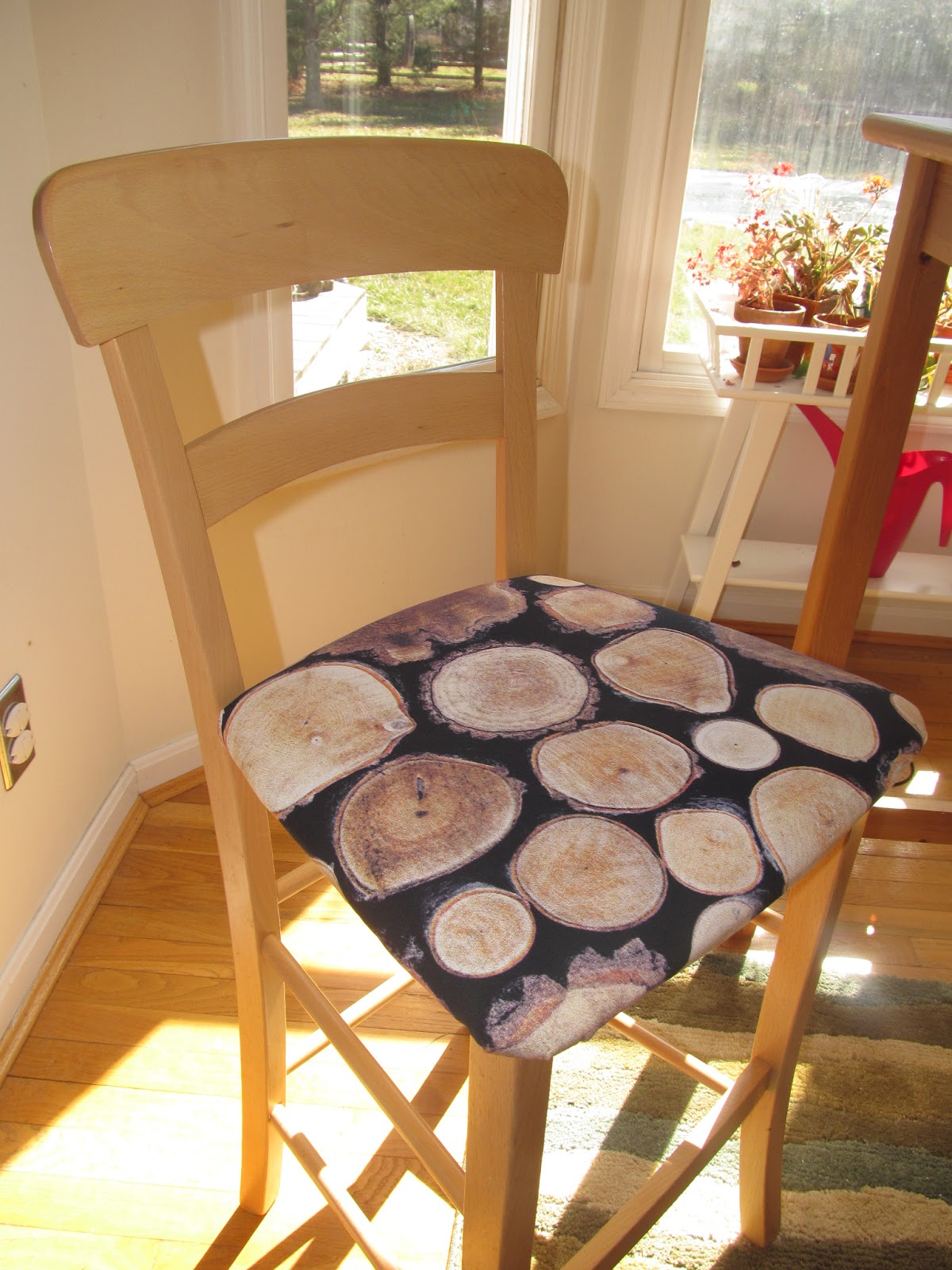
This was the poor state of them before this week. I bought a yard of home decor weight fabric (love this log cross section fabric!) from IKEA (always measure your surface; I have some extra for a fun project later...), and had some fabric stabilizer and a staple gun standing by.

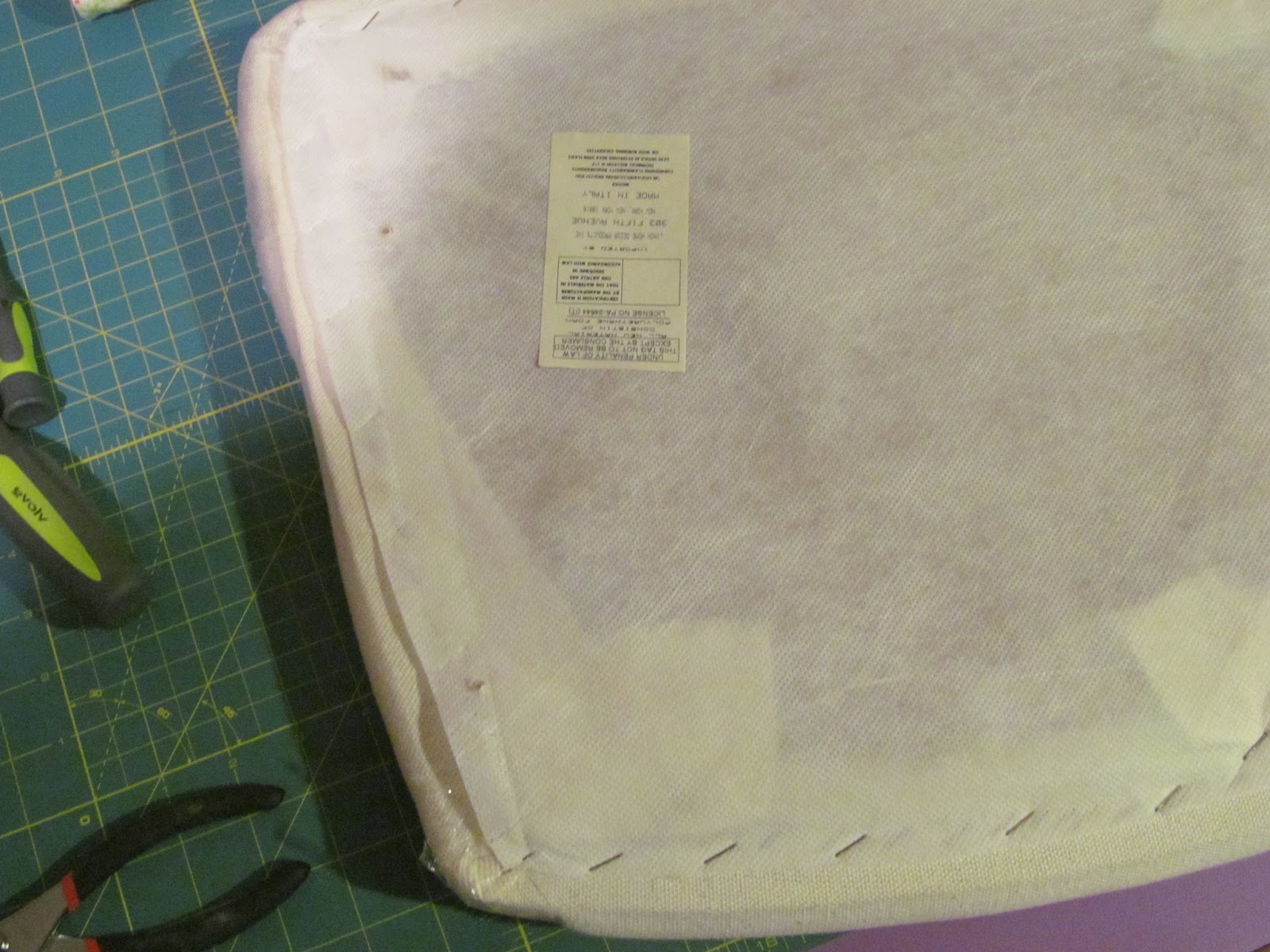
I started by detaching the seat from the frame and beginning the long task of removing the staples from the fabric.
It was a giant pain in the butt, but with a standard screwdriver and a pair of pliers, I was able to get it done. I kept the seat fabric to measure for the new seat. I ironed the old seat so it would lay flat for measuring and cutting. Now you can REALLY see why this needed to be done. :) Cut around the old seat, and you have your new one! You probably don't have to do this, but I'm kind of anal-retentive and want everything to be perfect so I did a quick blanket stitch around the outside of my new seat fabric to prevent fraying.
Luckily, my old seat's foam padding was just fine so I didn't have to replace that. Now I'm ready to staple the new fabric!
 I started at the back of the seat and started stapling from the middle. That way you can work in to the corners and get them the way you want them. I noticed when I was undoing the old seat fabric that there was a sort of plastic stabilizer so I decided to use some fabric stabilizer I had on hand. Just to keep the staples from pulling the fabric. It was around $7.99 for 10 yards, and I already had it. It seemed like a good idea. :)

I tried to work all 4 corners to be as flat as I could manage, and they all had extra stapling. It was more trial and error than anything. I had to take out staples a few times to rewrap. At this point, while you're wrapping, it might also be a good idea to mark the existing screw holes on your fabric so you don't staple them and so you know where they are for reattachment. I didn't mark them, but everything worked out fine.
When I was done wrapping the seat, I realized I didn't get enough fabric for the bottom cover. So... I decided to use the old seat fabric. :) I cut it using the old bottom as a template, and I, of course, had to do a little moving around to get it in a good spot that didn't have holes in it. I also turned it over so the side of the fabric that was facing out before was now to the inside of the seat. I also did a quick blanket stitch around this piece of fabric because it's more important that this one doesn't unravel and look unsightly. Then, staples all around, and voila!
Reattach it to the frame, and you're golden. Now we have our brand new old dumpster chairs. For the cost of free + $7.34 for the fabric, these chairs couldn't have been a better investment. :) Happy Crafting!

Monday, March 18, 2013

Joey's New Bedsheets

I have finally finished that poor boy's sheets. He's had the same 2 sets of bedsheets for over 3 years, but no more! I thought, "Hey, how hard could it possibly be to make a sheet. It's a flat piece of fabric with some corners in it." It turns out, it wasn't that hard, it was just kind of a pain in the butt. The great part about the process, though, was that I got to take Joey to the store with me so he could pick out whatever pattern he wanted. We both had a good time with this part.

The first set of sheets I made was made from some Cars fabric Joey picked out. If you missed it the first time, the pillowcase pattern can be found elsewhere on my blog HERE. Super easy stuff, and it took me about 20 minutes to make.
The second set of sheets we made (I say we because he's a very good helper and would want credit, I'm sure), was made from some dump truck fabric he picked. Now, I couldn't stand to make an entire bedsheet out of the super busy dump truck pattern so I made the pillowcase using the dump truck fabric and picked out a coordinating fabric for the actual bedsheet. You'll see what I mean in a second. I made this pillowcase the exact same way with the exception of the added grosgrain ribbon embellishment. I took that out and used some decorative stitching on the outer hem to have a little fun with my new sewing machine. :)
You can't see it very well in this picture, but the bedsheet is a fabric with all sizes of grey circles. I thought it looked like rocks all piled up, and it goes really well with his pillowcase. And also, he's a hammy turkey. :)

So, now to get down to business! The pattern I used for the bedsheet can be found HERE. The guys at Michael Miller Fabrics did an amazing job with this pattern as it was very easy to read and complete. I did, however, need to make some changes to suit my own needs. For Joey's bedsheet (please be sure to measure your mattress!), I had to add 2" to the length. On the other hand of that, the pattern calls for 45" in fabric width, and I did just fine with 42". I couldn't find anything at JoAnn's that had 45" length.

I also decided to use 3/8" elastic as the 1/4" they suggest looked way to flimsy when I went to buy it in the store. I wanted a little extra strength assurance. That also changed the hemming measurements: I folded the hem over a full 1" and then folded back under 1/4" (same in the pattern) in order to fit the wider elastic. It is always suggested that you leave 1/4" on each side of your elastic track. So if your elastic is 3/8" wide, you need a track that is 7/8" wide. I was short about an 1/8", but with my bodkin and my super-savvy threading skills, it worked just fine.

I always encourage you to make your decor your own, and this is a really easy way to do it. Don't let it intimidate you! I do get a little overwhelmed by my crafts sometimes, but, if I just sit down and do it, everything works out just fine. And if it doesn't, you can always give it as a gift. ;) I'm looking forward to getting to make Rosie's sheets when hers start to get old. :) Happy Crafting!

Monday, January 28, 2013

Update Your Mangy Ironing Board

Okay, so maybe your ironing board cover isn't mangy, but mine certainly was. So I fixed it.
How do these things get so dirty, anyway? I've never ironed anything but clean clothes. Anyway, here's a nice easy, maybe a little dirty, tutorial for you to use when you'd like a little change on the ironing board.

Ironing Board Cover Tutorial

Materials:
* Measure your ironing board to get an idea of how much fabric you'll need.  Mine is 56" long so I just got 2 yds.
*1/8" cord
*toggles for the cord
*coordinating thread
*ruler
*water soluble pen

Remember to always wash your fabric before sewing.

1. Remove current board cover and inspect underlayment to make sure it’s still usable. If it’s not, you’ll have to get something to replace it. Mine was foam, and it's fine. Awesome.

 2.  Lay fabric down on top of your ironing board facedown making sure to leave a few inches around the edge of the fabric. Trace around the ironing board with your marker.
  • If you wanted to make a paper pattern that you could use whenever you wanted, you could do that, too. The following steps will be the same, you'll just use paper.
3. Lay your fabric down again (right side down again) and mark around your traced pattern at 3”. This will give it room to hang down around the ironing board and for you to make your casing for the cord. 
4. You can connect the lines if you want (I did). I know it’s a weird shape, but if you spaced your 3” marks close enough together, it’s just like connecting the dots. Cut out the shape.

5. Place the fabric right side down. Mark in at ¾”. Mark in and pin/press at ¼”.

6. Pin/press again at the marks you made at ¾”. Yes, you will have some gathers around the corners, but just press them down (hospital corner style) and sew right on top of them. 
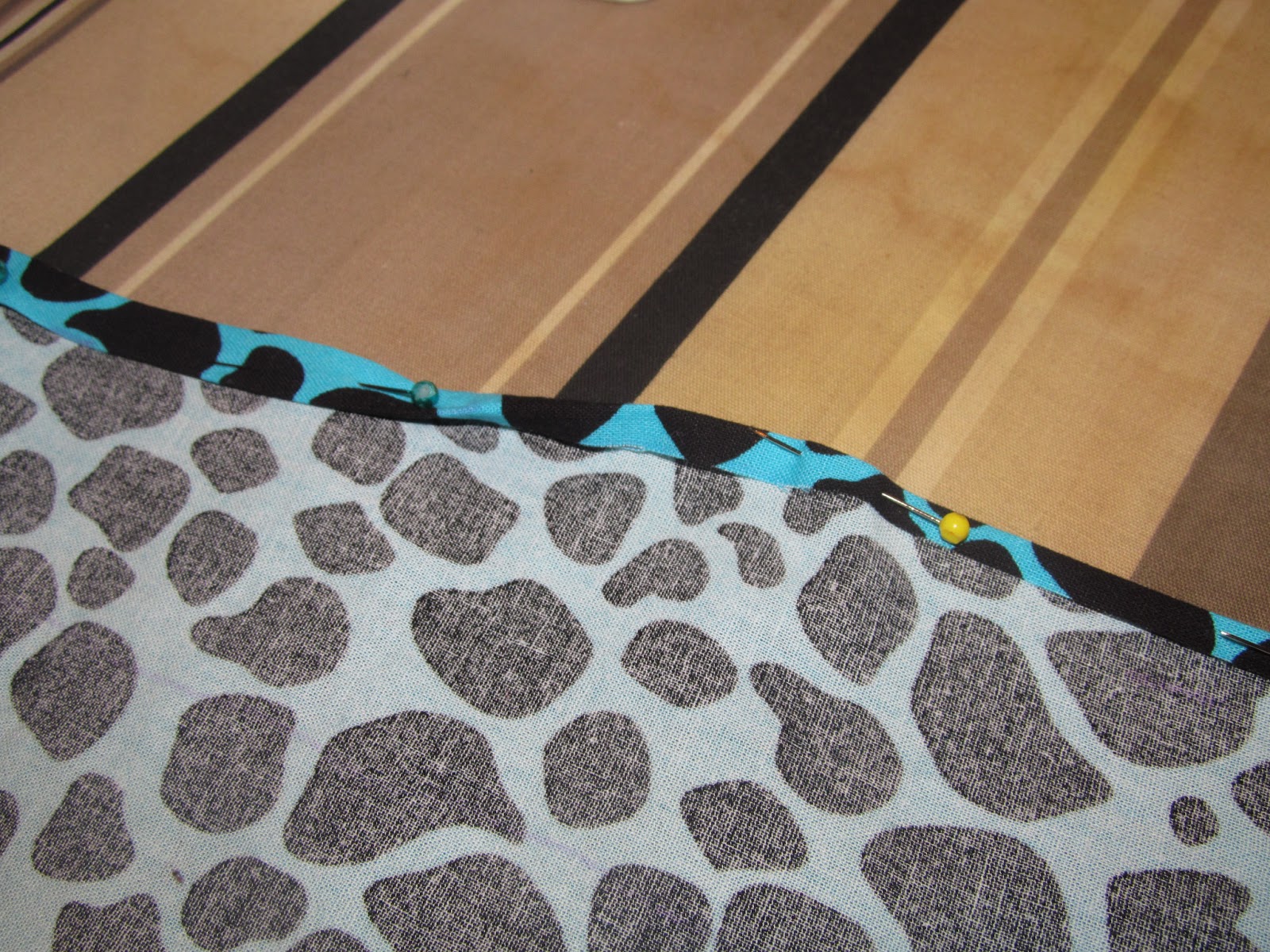
  • You can see where I've already pressed and pinned the 1/4" section (on the right side of the photo). Then I went back and folded the fabric again to the 3/4" marks (on the left side of the photo).
7. Mark a 1” space at the very point of the pattern for a spot where you can insert the cording. Do not sew this part closed!

8. Sew as close to the inside pressed hem as possible. I always like to press my hems when I'm done so they look nice so you can do that, if you'd like.
9. Attach a safety pin (or elastic threader) to the end of your allotted cord length and thread it through the casing where you left your opening. Make sure you’re threading the cord through the casing entirely. That probably means you’ll have to go back and straighten out the fabric where’s it's bunched up because of the cord going through it. This will make it easier to tighten it at the end.

10. Put your cover on your ironing board and pull the cord tight making sure the cover surrounds the board on all sides evenly so you don’t have any weird bunches or wrinkles.

11. Thread the toggle on the exposed cord on the end and tighten it to bring the cover very close up around the board. 
12. Step back and admire. Maybe have a drink. Mmmm... drinking and sewing...
Everyone needs some teal giraffe print in their lives. Happy Crafting! 

Sunday, January 20, 2013

Easy Toddler Pillowcase

I welcome you to Joey's first pillowcase tutorial! We figured he was old enough to have his own pillow, and I wanted to encourage him to welcome the change (he's NOT good with change) by having him pick his own pillow fabric. Fun, right?

Easy Toddler Pillowcase (14" x 20" pillow insert)

*Fabric of your choice (I bought 1 yard, but you could get away with 1/2 provided you'll be doing a cuff also)
*ribbon or extra fabric for embellishment
*coordinating fabric for the cuff
*coordinating thread

Seam allowances: 1/2" unless otherwise stated.

1.  Prewash and iron the fabric. This will make it easier to work with.

2.  Cut the fabric. This is ALWAYS my least favorite part...
    • Case: 32" x 15-1/2" (you'll be folding this in half to cover the pillow)
    • Cuff: (2) 15-1/2" x 7"
    • embellishment: (2) 15-1/2" x 7" (I used 3/4" grosgrain ribbon)
3.  Baste the embellishment onto the right side of the cuff fabric as close to the edge of the embellishment as possible. It depends on how much embellishment you want showing, but I moved mine in 1/4" so I had 1/2" of ribbon showing on the pillowcase.

4.  Then, I folded in and ironed my 1/2" hem on the short side of the case fabric and pinned the cuff fabric right underneath it but only as far in as the 1/2" seam. Sew as close to the edge of the case fabric as you can get. Then, I sewed a second seam 1/4" away from that one.
  • So you see, I have the case fabric on top (right side up) with the cuff fabric (also right side up) and basted ribbon underneath at the 1/2" seam line.
5.  Fold assembly in half with right sides together. You can take a look and make sure your embellishments line up, if you like. I took a peek, but I didn't really care all that much. :) Sew your 1/2" seam on both long sides.
6.  Now you can turn it right side out and press all your seams.

  • It looks really nice when you fold the fabric in half instead of sewing those 3 sides.
7.  Measure 1" all around the cuff and fold/pin/press the fabric in at this point.

8.  You can use whatever color thread you like, but I chose a contrasting red color to bring in more of  the color of the case fabric. Sew at 5/8" and then again at 7/8" for a nice look. 

9.  Press one more time, admire your work and you're done! 
  • The contrasting color thread on the black cuff looks really neat!
After I finally figured out all my dimensions, it only took me about an hour to put this together. Now that I have my instructions, the next one will be even quicker. Will I be moving on to sheets? I have NO idea. We'll have to see how brave I get. :)

For now, we'll be building Cars-themed fluffy pillow forts and sleeping comfortably. 

Thursday, August 2, 2012

The Perfect Pillow

In the recent very long search to find the perfect back support pillow for Baby 2.0's new green glider, of course, we found nothing we liked. I'm sure you've noticed this happens a lot. I did, however, find the perfect fabric at Hancock Fabrics. So I went for it! This is probably one of the easiest projects you will ever take on if you ever need a nice decorative (or fully functional) pillow for a certain space.
It goes along with our color scheme perfectly (grey, blue, lime green and pink), and we were able to get just the right size pillow form. So I did get the pillow form, I got a yard of this gorgeous fabric (in case I wanted to make other things with it), some 7/8" wide black satin ribbon and a couple buttons for the envelope closure at the back of the pillow. Easy peasy.

I cut the fabric to fit the form so the finished size was exactly the size of the pillow, in this case 12" x 16". The hardest part was definitely working that satin ribbon around the edges. I wanted something to break up the front and the back of the pillow, but I have never done piping or anything like that. I took the cheater's way out, and I folded the satin ribbon in half and sewed it right to the pillow cover. It was a bit tricky, but I LOVE the way it turned out.
Adding the buttonholes, and consequently the buttons, was the finishing touch on this lovely addition to the nursery. I chose some giant buttons so they were more of the design of the pillow as opposed to just being functional. They look good, too. :)
And voila! You have a beautiful personalized back support (or decorative, if that's your thing) pillow that you have created yourself. Not to mention it took all of a couple hours to finish this project. I love quick projects! Happy Crafting!


Monday, June 18, 2012

Easy Peasy Valance for Dummies

I don't mean to offend anyone with this title. This just perfectly describes my relationship with sewing and making pretty things quickly and easily. I get bored pretty quickly so it's best if I can make something nice very easily. It has also struck me that this is my first tutorial. Yay! I'm very excited, and I'm sure something will go wrong, but this is a good one to start with. Again, easy.

So our house has these ugly, old, dirty venetian blinds that we never use in certain windows, e.g. our kitchen window above the sink (a). They're the windows that we never cover because they let in awesome light during the day. I tried taking down those ugly venetian blinds and found that underneath them it was even uglier (b). So I had to come up with something to cover them up because there was NO WAY I was going to continue looking at those stupid, ugly venetian blinds just because it was uglier to remove them.


Easy Peasy Valance for Dummies

fabric cut to window (width inside trim + 2in) and (desired height + 4in)
coordinating sewing thread
1" x 2" batten (cut to finished width of window)
(2) 1-1/2" L brackets
staple gun
power drill
tape measure (not pictured)
1.) The first thing I did was cut my fabric to the appropriate size. I added 2 inches to the width and 4 inches to the height. I found it was helpful to label the top and bottom of my fabric so I didn't get confused later. Trust me, it happens.

2.) Stitch a zigzag stitch (or serge, if your machine does that) all the way around the piece to lock in the threads.

3.) Fold and pin both the left and right sides of your fabric in 1 inch on the wrong side. Sew a 3/4 inch seam allowance in a coordinating thread color.

4.) Fold and pin the bottom of your fabric in 1 inch on the wrong side. Sew a 3/4 inch seam allowance in a coordinating color.

And you're done sewing! Wasn't that easy? Now we're going to work on hanging and installing your valance.

5.) Cut your batten down to size. I like to make it about 1/4 inch shorter than the width of my finished valance just so it tucks inside the fabric nicely.

6.) Lay the batten down (with the 2 inch surface down) on a secure surface. Align your completed valance right side up on top of the upward-facing 2 inch surface of the batten (a). Ensure the edges are lined up evenly with the edges of your batten and the top edge of the valance is even with the top edge of the batten. Staple your valance to the batten (b).

7.) Fold your valance over the batten so you are looking at a finished valance with the staples in the back. Lay the valance assembly right side down and measure about 5 inches in from each side of the batten to screw in your L brackets for installation. I always make sure the top of the L brackets go above the batten just a bit so there's extra room for installing it to the inside of the window trim.

8.) Now all that's left to do is install your valance inside your window trim and make sure it's level and even. Or at least as level and even as you want it. :) Just a side note: you CANNOT see the wooden batten from the outside. I checked.


And you're done! Now you can (and should) admire your beautiful handiwork.

Here's another one I did in our breakfast nook. The sunlight's amazing in there, and we NEVER put the curtains (or the blinds previously) down. I also made roman shades out of this same fabric for the other 2 windows in the breakfast nook, but that's a whole different can of worms and a subject for a later date. Happy Crafting!